Book Review: 'LANDSCAPE PAINTING' by Alfred East A.R.A (1906)
Updated: Oct 19, 2025

Alfred East (1844 - 1913 ) was an English painter from Kettering, Northamptonshire. He studied at the Glasgow School of Art, eventually elected as president of the Royal Society of British Artists, a member of the Royal Academy, and even being awarded a knighthood for his contribution in the Arts. Very active as a Painter, member of the Artistic commnunity and an Author and educator.
His work can be viewed at 'Alfred East Art Gallery' in his hometown of Kettering, Northamptonshire
Some of Alfred East works


'LANDSCAPE PAINTING in oil colour' by Alfred East A.R.A. published by Cassel and Campany, Limited
can be read for free at
If you want physical copy
https://www.ebay.co.uk/sch/i.html?
REVIEW:
First of all, I came across with the book in a charity shop. The big size and bright red colour caught my eye, and the title demanded of me to pick it up and inquire. I must confess that prior to this I had never hear of Mr. East before, but a quick glance over the book and seeing some of his work convinced me enough to make the purchase.
One of the things I love about buying second hand books, aside from the fact that they are often cheaper, is also that they have history of their own, and this books is no different.
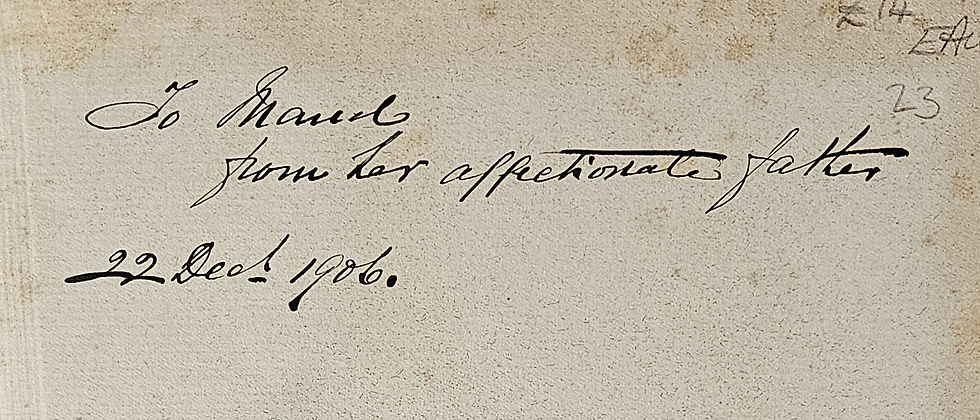
Signed in 1906 , a father to the daughter Maud. A beloved gift 100 years ago! Makes me both smile and a tad sad to know that is now in my hands, but out of respect for this family that I know nothing about, this book is now in good caring hands and read(again) cover to cover.

Its worth mentioning before reviewing the book, that how things were taught, generally speaking, have changed in part due to technology since the publishing of this book. The technology of, photography, printing, access to information, to name a few.
Modern art instruction books being more focus on techniques, processes, complimented by lots of visual guidance (allowed by above mentioned advancements), which makes access to information far more direct with empahsis on the practical (step-bystep breakdowns) and theoretical(the scientific explanations), but often very little to no empashis on the philosophical.
By contrast, there was more weight on the philosophical aspects in older books. The theoretical and practical being woven along in the middle. The style of writing is also more lyrical. I may be guilty of romanticizing older books, but its how I generally interpret major difference btween past and present books.


This book speaks directly to the reader, in my mind, it came across as a painter 'Uncle' of sorts. Tries to motivate and guide the reader, but above all tries to bring awareness on the subject
"I am of opinion that the cause of a great many of the failures, amongst those who know something of the technique of painting, is their false attitude towards Nature..." p.V Preface
"my present aim is to encourage the student to observe, and he will reap ample reward in the many surprises of this fascinating research" p.78
"...on a misty morning he thought of Corot, and if the morning were breezy he remembered Constable. I said, "Why don't you remember yourself? Aren't you a man?" That is what I want you to remember, and I say it again, at the risk of repetition, you are to work in the spirit of the old Masters, and not in the letter." p.38
Alfred East, like many of his time and definetley to painters prior to him, believe the Artist not purely as a recording entity, to merely copy what is in front of them, but to move and change Nature in pursuit of 'Beauty' and 'Truth'
"... in Nature we hear the whisper of their leaves and know that they live and breath. To express that, is a greater truth than the camera can reveal, and a higher form of realism. " p.54
"... painter saying to me, "I see foliage hard against the sky as an edge mass." I answered, "So do I, but I do not feel it so." " p.56
" "May I," you ask, "take a tree from this place because its form and outline suit my composition, and put it here, in the place of a tree in Nature that is not so suitable to my purpose?" Yes, you may; there is no law forbidding. You have as much right to replant your tree as the peasant who planted it there originally. " pp.90-91
On a more technical advice that I thought interesting to highlight, two that stood out due to contradicting the general advice and the other simply because is uncommon to hear.
The first one being, to paint the sky last. Rather than what is commonly done, which is painting the sky first.
" "Why not paint the sky first?" I know you have been told to do so, and as every painter has a reason for what he does, let me explain why I should not. It is much easier to paint a sky to suit a landscape than a landscape to suit a sky." p.16
The other advice is to paint the foreground without mixing prior on the pallete but using pure colours, to use broken colour by placing one next to the other.
" Do not mix your colours on your palette; take a little of each(pure) on your brush, and place them on the canvas." p.74
And to contrast with the advice above, the background ought to be painted , by colours pre mixed on the palette and more flat on the canvas
"...for the extreme distance your colour should be mixed in your palette." p.101
The idealization here is how it 'feels' and East often comes back to this point. To often go to Nature to study its effects, to be out to 'experience' Nature in all its glory. The Artists as the vessel and conduit, so on the canvas what is conveyed is not a copy, but a memory, an experience that is faithful to both the Artist as an individual and also to the light effects and colours at that point.
The studies done out in Nature as references, and the personality of the Painter should not be excluded in the process.
"Your picture may be said to be finished when it would be superfluous to add another touch to it, and when it rings in perfect harmony and rhythm of line and mass of tone and colour. The beauty and dignity of your composition, your scheme of colour, and all the personal and individual expression of your painting, should be full of that great quality which must be the dominant note of your picture, and that is the expression of the vital force and the convincing truth of Nature. " p.106
I enjoyed a lot, I read these books to 'hear' their particular attitudes, philosphy and world views. It left me wanting to go landscape painting. Like having a good chat with a passionate landscape painter. However, when compared to modern books or other instructional video guidance, aside from its philosophical points, is short in more visual support.
Another point regarding older books is that some of the recommendations are less practical to modern audiences with better alternatives, such as easels, pigments and other materials.
Good companion to other landscape books.
1/5 *


Comments